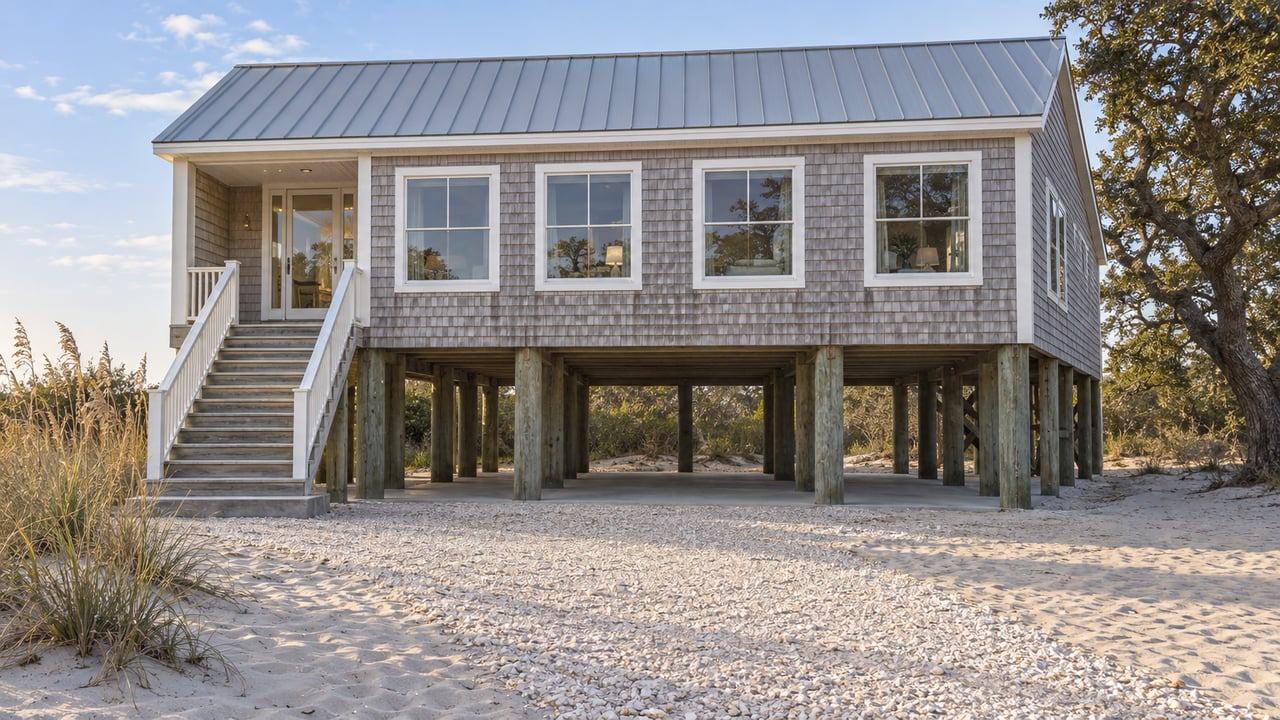
A Corolla rental home listed as "sleeps 16, six bedrooms" and a Corolla rental home permitted to sleep 16 across six bedrooms are not always the same house. Sometimes they are. Often, on the Outer Banks, they are close enough that nobody checks. But the gap between what a listing says and what the county's septic permit allows is exactly where a buyer's income projection, an appraiser's comp pool, and a seller's asking price can quietly stop agreeing with each other.
Most buyers treat "bedrooms" the way they treat square footage: a fixed, verifiable fact printed on the listing sheet. On the Outer Banks, it isn't. It's closer to four separate numbers that a single house can carry at once, and only one of them decides what you can legally rent the place for.
Four Bedroom Counts, One House
Walk through what "bedroom count" actually means on a Corolla property and you find four different answers, each kept by a different authority for a different reason.
| Who's counting | What they count | Why it matters |
|---|---|---|
| The MLS listing | Whatever the marketing photos show | Drives buyer interest, not legal capacity |
| The tax record | What was on file when the home was built or last assessed | Often the fallback when other records are missing |
| The septic permit | The number the local health department approved for wastewater capacity | Sets legal occupancy and rental income ceiling |
| The HOA covenant | However the community's declaration defines "bedroom" | Can require parking or fees per bedroom, independent of septic rules |
Corolla Light's own Declaration of Covenants is a good example of the fourth column. Its restrictions require at least one paved or stoned parking space for every bedroom in a structure, and the declaration defines a bedroom for that purpose as any room that could be used to increase the number of occupants a house can hold. That's a bedroom count set entirely by parking logic, filed with the Corolla Light Community Association, and it has nothing to do with what the county's environmental health office approved for the septic system next door.
So a room can be a bedroom to the HOA and not a bedroom to the health department. It can be a bedroom in the listing photos and not a bedroom on the tax card. None of these disagreements are unusual. What's unusual is how rarely buyers ask which one actually governs.
The number that determines your rental income isn't the one on the flyer. It's the one filed at the county health department.
Why the Septic Permit Wins
North Carolina's Real Estate Commission has spent more than a decade publishing guidance on this exact problem, because the same complaint keeps recurring at the beach: a broker advertises a house as having more bedrooms than the septic system was designed to support.
Here's the mechanism. When a home isn't on municipal sewer, the local health department evaluates the lot and issues a septic permit that caps the design at a specific number of bedrooms. That permitted number, not the room count in the listing or the number of beds physically in the house, sets the maximum occupancy the property can legally support. The Commission's guidance is explicit that occupancy levels are determined by the number of bedrooms allowed by the septic permit, and that advertising more bedrooms than the permit supports risks a misrepresentation finding against the broker.
This isn't a technicality that only matters if something breaks. A lender's appraiser may ask about the septic permit, and its bedroom count can affect which comparable sales apply to your purchase. Most directly, it determines how many guests you can legally advertise for on a rental platform: a house with three physical bedrooms and a permit good for two is limited to two bedrooms for rental-occupancy purposes.
What This Costs in a Market Built on Big Houses
This distinction carries more weight in Corolla than almost anywhere else on the Outer Banks, because Corolla's rental inventory skews toward large homes built specifically to sleep a crowd.
The most recent published breakdown of Corolla's short-term rental market, dated as of April 2026, counted 144 active listings, with four-bedroom homes leading the mix at 39 listings, six-plus-bedroom homes close behind at 38, and five-bedroom homes at 28. Larger homes in the five- to six-plus-bedroom range were earning an estimated $110,000 to $125,000 annually, with peak-season revenue averaging $29,477 in August, $24,570 in July, and $15,313 in June for a typical listing.
Every one of those figures assumes the advertised bedroom count is the legal bedroom count. If a six-bedroom rental's septic permit only supports five, the honest advertised occupancy drops, the honest nightly rate math changes, and the income projection a buyer built their offer around no longer holds. This is the quiet variable behind the sticker price on a big Corolla rental house: not the finishes, not the pool, but whether the county's paperwork actually backs up the bedroom count the listing is selling.
Before You Write an Offer, or List Your Home
A few minutes of verification up front avoids a much more expensive conversation at closing.
- Ask your agent to pull the septic permit from Currituck County's Planning & Inspections office before you finalize an offer on a home not connected to municipal sewer.
- Compare that permit's bedroom count against the tax record and the MLS listing. A mismatch between any two of them is worth a direct question to the listing agent.
- If you're buying in a covenant-restricted community, check whether the HOA's own definition of "bedroom" differs from the septic permit's, especially if a bonus room or den is part of the appeal.
- If the permit can't be located, ask what the seller and listing agent know and get it in writing rather than assuming the advertised count is accurate.
Currituck County's Permit Coordinator, Stacey Smith, handles these records out of the Planning & Inspections office at the Currituck Historic Courthouse, and property owners can also search existing permits through the county's Citizen Self Service portal once an account is linked to their property. It's a short call. It's a much better use of an afternoon than discovering the mismatch during a mortgage underwriter's review.
The Barrier Island Complication
Corolla's geography makes this harder to fix after the fact than it would be almost anywhere inland.
Sandy, fast-draining soil sounds like it should be ideal for a septic system, and that intuition is backwards. A 2026 review of coastal North Carolina septic regulation notes that the sandy soils common on barrier islands, classified as Group I in the state's system, let effluent pass through so quickly that the biological treatment process doesn't have time to work properly. That's part of why barrier-island installations in coastal counties routinely need engineered systems rather than a standard gravity-fed drain field, and why those systems cost more to install and maintain than a comparable inland lot.
Local septic contractors who work Corolla directly, including Stuarts Septic and Juniper Ridge Construction, describe the same split every barrier-island buyer eventually runs into: mainland Currituck properties face flat terrain and high water tables near the sound, while the coastal side of the county deals with saltwater intrusion and soil that drains almost too well.
Space to fix a permit that's come up short is also limited by rules that have nothing to do with septic design. The Coastal Area Management Act sets a mandatory buffer of roughly 75 feet from estuarine shorelines, along with ocean hazard setbacks that vary by lot width and erosion rate, and Island Contractors OBX reports that most Outer Banks towns cap total lot coverage around 30 percent. On a narrow soundfront or oceanfront Corolla lot, those two limits together can leave very little room to expand a drain field even if the owner is willing to pay for it.
If You're the One Selling
The same permit that caps a buyer's rental math also matters to sellers. If the permit can't be located, the honest move is to say so plainly rather than let the advertised bedroom count stand unquestioned. Sellers who locate and confirm their permit before listing avoid the harder version of this conversation, the one that happens mid-contract when a buyer's lender asks a question nobody was ready for.
If your home's septic permit supports fewer bedrooms than the house physically has, that's worth knowing before you set a list price, not after an offer comes in built around a bedroom count the property can't legally support.
A Few Questions Worth Asking
What if the original septic permit can't be found? Older Corolla homes sometimes predate consistent record-keeping. In that case, the honest path is disclosing that the property has an on-site system but that the permit couldn't be located, while checking tax records for any indication of the originally approved bedroom count.
Does this apply to soundfront and oceanfront homes the same way? Yes, and often more acutely, since those are the narrower lots where CAMA setbacks and lot coverage limits leave the least room to expand a system if the permit turns out to be short.
Can a den or bonus room just be converted into a legal bedroom? Sometimes, but on a small or already-developed lot, there may be little room for changes to the septic system.
If you're comparing Corolla properties and want a straight answer on what a specific listing's paperwork actually says before you write an offer, or you're getting ready to list and want the permit question settled ahead of time, Ashley Massey has spent more than 26 years working through exactly this kind of detail on the northern Outer Banks. Let's Connect.
This article is general information, not legal, tax or financial advice. Consult a qualified professional about your situation.